
The AI Scapegoat: Why 180,000 Workers Really Lost Their Jobs



The Email We're All Dreading
Let’s talk about Sarah. For five years, Sarah was the go-to person on her marketing team. She wasn’t just good; she was the one you’d Slack at 4:55 PM with a nightmare problem because you knew she could fix it. She consistently exceeded her targets, mentored junior employees, and had a file of glowing performance reviews that could make a CEO blush. So, when the calendar invite from HR popped up on a Tuesday morning, her first thought was a promotion. It wasn’t.
The email that followed the ten-minute call was a masterclass in corporate doublespeak. It was polite, vaguely apologetic, and utterly devastating. The key line was buried in the second paragraph: “Due to our strategic pivot toward AI-driven operations and the need to streamline efficiencies, we have made the difficult decision to eliminate your role.” Sarah was being replaced by an algorithm. A cold, heartless, but supposedly hyper-efficient new reality.
But here’s the twist. The AI system that was supposed to replace her? It wasn't just buggy. It wasn't working. At all. Her former coworker spent the next three weeks sending her frantic texts, complaining about how the new "AI content generator" was spitting out gibberish and the "automated workflow tool" kept deleting crucial files. The "strategic pivot" was a nosedive, and the company was quietly hiring freelancers to plug the gaps. Sarah wasn't replaced by the future; she was a casualty of a lie.

The $40 Billion Lie
Sarah’s story isn’t an isolated incident. It’s the micro-tragedy at the heart of a massive, global narrative. For the past year, we've been hit with a relentless barrage of headlines from the biggest names in the game. Salesforce, Accenture, Klarna—all announcing massive layoffs, all pointing a finger at the same futuristic culprit: Artificial Intelligence. The message was clear: the robot revolution is here, and it’s coming for your job.
There’s just one tiny problem. The revolution is a bust. A bombshell study from the Massachusetts Institute of Technology (MIT) looked at the tsunami of cash companies are throwing at AI and found something staggering:
95% of companies investing in AI get zero return on investment.
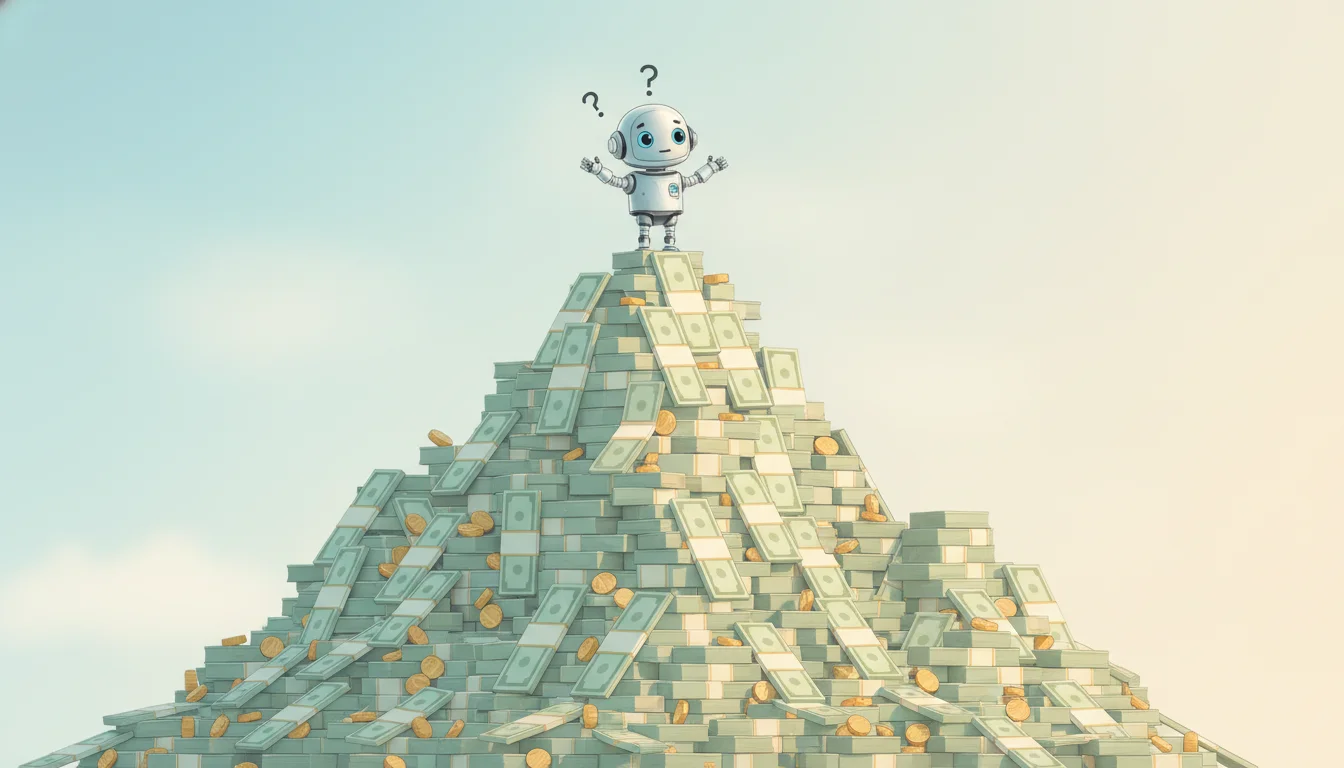
Let that sink in. We're talking about a collective spend of between $30 and $40 billion that has effectively vanished into a black hole of buzzwords and broken promises. Companies are pouring fortunes into technology that, for the vast majority, produces no tangible value. They are buying the hype, but not the results.
This raises the real, burning question at the heart of this whole mess. If the AI isn’t actually, you know, working for most companies… why are they firing 180,000 people and blaming it for the carnage?
Welcome to the AI Excuse Economy
The answer is as simple as it is cynical. We’re living in what Fabian Stephany, a researcher at the University of Oxford, calls the “AI Excuse Economy.” It’s a phenomenon where companies use the idea of AI as a public relations shield to hide something much more old-fashioned and embarrassing: bog-standard cost-cutting and correcting their own past mistakes. AI has become the ultimate corporate scapegoat.
The data backs this up with brutal clarity. While the headlines scream about an AI takeover, the New York Federal Reserve released a report showing that a mere 1% of service firms reported actually laying off workers due to artificial intelligence. One percent.
Now, let's put that in perspective. In 2025 alone, we're on track for 180,000 tech layoffs. That's 489 people losing their jobs every single day. If AI was only responsible for 1% of that, the narrative completely falls apart. The math just ain’t mathing. The overwhelming majority of these layoffs have nothing to do with a functioning, job-stealing AI and everything to do with a C-suite in need of a good excuse.
Behind the PR Curtain: Naming Names
The "AI Excuse Economy" isn't a theory; you can see it in action by looking at what the corporate giants say versus what they actually do.
Salesforce: CEO Marc Benioff made waves by claiming AI could do “50% of the work,” a statement that perfectly primed the market for their layoff announcements. But when pressed, a company spokesperson quietly admitted that the cuts were just part of a standard restructuring and that many employees were simply “redeployed” to other roles. It wasn’t a robot takeover; it was a re-org with a sci-fi paint job.
Klarna: The fintech company became the poster child for AI replacement, with CEO Sebastian Siemiatkowski boasting that their AI assistant was doing the work of 700 customer service agents. The story went viral. What got less attention was his later LinkedIn post, where he had to do damage control, admitting there had been “0 layoffs due to AI.” The reduction in staff, he clarified, was due to “natural attrition”—people quitting and not being replaced.
Accenture: This one is a masterclass in corporate spin. The consulting firm announced it was cutting 11,000 jobs to "reskill" its workforce for an AI-powered future. The problem? They announced this while also reporting a 7% increase in revenue for the quarter. They weren't struggling; they were thriving. The layoffs were a pure profit-boosting move, dressed up as a noble quest for innovation.
The ultimate proof? Both IBM and Klarna, after making huge PR splashes about their AI customer service bots, had to quietly reverse course and rehire humans. Why? Because the AI was failing. Customers were furious, and the bots were incapable of handling complex problems. The technology they used to justify downsizing simply wasn't ready for prime time.
The Real Culprit: A Pandemic-Sized Hiring Hangover
So if it's not the rise of the machines, what is the real reason for the mass layoffs? Imagine you're a CEO. You have two options.
- Option A: Go to your board and shareholders and say, “Whoops. We got caught up in the 2021 hiring frenzy, over-hired by about 20%, misread the market, and now we have to fire thousands of people because of my poor strategic planning.” This makes you look incompetent.
- Option B: Go to your board and shareholders and say, “We are a visionary, forward-thinking company on the cutting edge. We are strategically realigning our workforce for an AI-first future to unlock unprecedented levels of productivity.” This makes you look like a genius.
You’re picking Option B every time. It’s a get-out-of-jail-free card. The truth is that the tech industry is suffering from a massive hiring hangover. During the 2020-2021 pandemic boom, demand seemed infinite, and money was cheap. Tech companies went on an unprecedented hiring spree. Now, with interest rates high and demand returning to normal, all those extra employees are viewed as “inefficiencies” on a spreadsheet.
Companies are now conducting what Fabian Stephany calls “market clearance”—a cold, sterile term for correcting their past over-exuberance by firing people. But instead of admitting their mistake, they’re using the "AI transformation" narrative as the perfect PR tool. It sounds innovative, it pleases Wall Street, and it completely absolves leadership of any accountability.

The Unseen Victim: The Entry-Level Extinction Event
While the current layoffs are based on a lie, there is a real, insidious threat on the horizon, and it’s hitting the youngest members of the workforce the hardest. Dario Amodei, the CEO of AI-pioneer Anthropic, gave a chilling prediction: AI is poised to eliminate half of all entry-level white-collar jobs.
The data is already starting to bear this out. One analysis found a 13% relative decline in job opportunities for workers aged 22-25 in fields most exposed to AI. But here’s the cruel twist: it’s not because a super-smart AI is actively taking their jobs. It’s a "soft attrition" strategy.
Companies aren't investing in a brilliant AI to replace their junior graphic designer. They are simply not filling the position when the current designer leaves. The justification, spoken or unspoken, is that "AI will handle that work soon enough." This creates a silent, creeping erosion of the entry-level jobs that have always been the first rung on the career ladder. It’s an extinction event happening in slow motion, fueled by the promise of AI, not its actual performance.
Your Survival Guide for the AI Scapegoat Era
It’s easy to feel powerless, but you’re not. The first step is to understand the game being played. Here’s how you can protect yourself.
Reframe the Threat. Stop worrying about a robot taking your job tomorrow. Your job isn't being replaced by a sentient algorithm; it's at risk of being eliminated by a cost-cutting executive who is blaming a non-sentient algorithm. This is a human problem, not a technological one.
Be Visibly Valuable. In this environment, it's not enough to be good at your job; your boss's boss needs to know you're good at your job. Document your wins. Track your metrics. Connect your work directly to revenue or cost savings. Make yourself so obviously indispensable that you're not just a number on a spreadsheet.
Learn the Tools (But Know Why). Yes, you should absolutely learn how to use AI tools like ChatGPT, Midjourney, or Co-pilot. But don't do it as a defensive measure. Do it as an offensive one. The goal isn't to be "as good as" AI; it's to use AI to become a productivity multiplier, making you dramatically better, faster, and more valuable than your peers.
Watch the Money, Not the Marketing. Here’s the biggest red flag: if your company announces a grand "AI transformation" but you see zero investment in training programs, pilot projects, or new infrastructure, it’s all just PR for layoffs. A real transformation costs money. A fake one only costs people their jobs.
Embrace Disloyalty. The hard truth is that the era of company loyalty is over because it's a one-way street. Your best career protection isn't hoping your current company takes care of you; it's ensuring you are always ready for the open market. Keep your resume updated, your network active, and your skills sharp.
The Robots Aren't Firing You. Your Boss Is.
Let’s call this what it is. Tech companies spent tens of billions of dollars on AI, got almost no return on their investment, and are now using the lingering hype as the perfect smokescreen to hide their own bad business decisions and clean up their pandemic-era overhiring.
It's a brilliant, if soulless, strategy. Executives get to look like forward-thinking visionaries, while 180,000 people are left to update their LinkedIn profiles and wonder what they did wrong. The answer is nothing. They just got caught in the crossfire of the AI Excuse Economy.
The AI revolution isn’t taking your job. But the AI excuse might. The question is: are you going to fall for it?
What's your take? Have you seen AI used as an excuse for layoffs at your company? Share your story in the comments below and let's expose the pattern together.

Antriksh Tewari
Head of Digital Marketing
Antriksh is a seasoned Head of Digital Marketing with 10+ years of experience who drives growth across digital, technology, BPO, and back-office operations. With deep expertise in analytics, marketing strategy, and emerging technologies, he specializes in building proof-of-concept solutions and transforming them into scalable services and in-house capabilities. Passionate about data-driven innovation, Antriksh focuses on uncovering new opportunities that deliver measurable business impact.