
I Tried to Prove AI Was Sloppy. It Ended Up Refactoring My Career.


Let's be real: for the longest time, my opinion of AI in the coding world was pretty cynical. It was a glorified search engine, a party trick for refactoring simple functions, maybe a way to autocomplete some boilerplate. The idea of it actually building something complex, something with stakes? Please. I was convinced it was all hype and sloppy shortcuts. I was the seasoned developer, the craftsman. AI was the intern who talks a big game but messes up the coffee order.
I decided to prove it. I set out to find the flaws, to catch the AI in a lie. But in my quest to expose its sloppiness, I ended up exposing something far more surprising: the outdated definition of my own job.
My 76-Day Masterpiece, a Ghost of Projects Past
To understand my skepticism, you have to travel back with me about five years. I was working for a major Indian credit card company, and my team was handed a mission-critical task: build the company's first-ever comprehensive data flow for digital marketing. This wasn't just another pipeline; it was meant to be the single source of truth. Every business question—from campaign ROI to customer lifetime value—would be answered by this system. The pressure was immense.
I poured my life into it. The project was my baby, built from scratch in R. I remember a 16-day stretch of pure, caffeine-fueled restlessness where the lines between my keyboard and my brain completely blurred. Those sleepless nights weren't just about meeting deadlines; they were about building something robust, something I could be proud of. After the initial build, it took another 60 days for the entire ecosystem of marketing managers, analysts, and VPs to fully trust and integrate it into their daily workflows. That 76-day journey was a testament to human effort, meticulous coding, and the slow, deliberate process of building trust. It was my magnum opus, a ghost of projects past that defined my sense of professional pride.
Déjà Vu, With a Deadline from Hell
Fast forward to today. I found myself facing a familiar challenge, but the scale was terrifyingly different. The same bank, the same type of data-flow, but this time it was for their entire enterprise-level operations. The old system was a stream; this new one had to be an ocean, integrating a completely new, alien tech stack. The nostalgia of the old project quickly evaporated, replaced by a cold dread.
The tension was palpable from day one. If you’ve ever worked with high-stakes clients in India, you know the vibe. There's an expectation of magic, a demand for immediate results that defies the laws of physics and software development life cycles. "Indian clients being Indian clients" is a phrase we use with a mix of respect for their ambition and terror for their timelines.
And the timeline was the killer. They wanted this massive, complex system—something that should have been a six-month project, minimum—delivered in four weeks. Four. And the cherry on top? They demanded a full-scale progress validation in just eight days. I was tired before I even wrote the first line of code. I felt cornered, stressed, and set up to fail. The pride I felt for my 76-day masterpiece now felt like a taunt.
A Desperate Conversation with My Phone
Eight days in, I was exactly where I feared I'd be: nowhere. I was drowning in documentation, battling with unfamiliar APIs, and staring at a mountain of logic that refused to budge. The wall I'd hit wasn't just technical; it was a wall of pure exhaustion and defeat. I slumped back in my chair, the flickering cursor on my screen mocking my lack of progress.
In that moment of quiet desperation, I did something I'd never seriously considered. I picked up my phone, opened Google Gemini, and just… talked to it. It wasn't a strategic move. It was a "what do I have to lose?" Hail Mary. I laid out the whole impossible scenario, the tech stack, the deadline, the crushing weight of it all. I expected a generic, unhelpful "have you tried breaking the problem down into smaller pieces?" response.
Instead, the AI suggested something I'd only vaguely heard of: using "agentic coders." It described a new breed of AI tool that could take high-level instructions and manage an entire coding project. My skepticism immediately kicked back in. To me, AI was for finding syntax on Stack Overflow or cleaning up a messy function. The idea of it handling an entire project architecture felt absurd. But desperation is a powerful motivator. With a heavy sigh and zero expectations, I downloaded the new VS Code-like tool it recommended.
Armed with 'AHA!', I Went to War with the AI
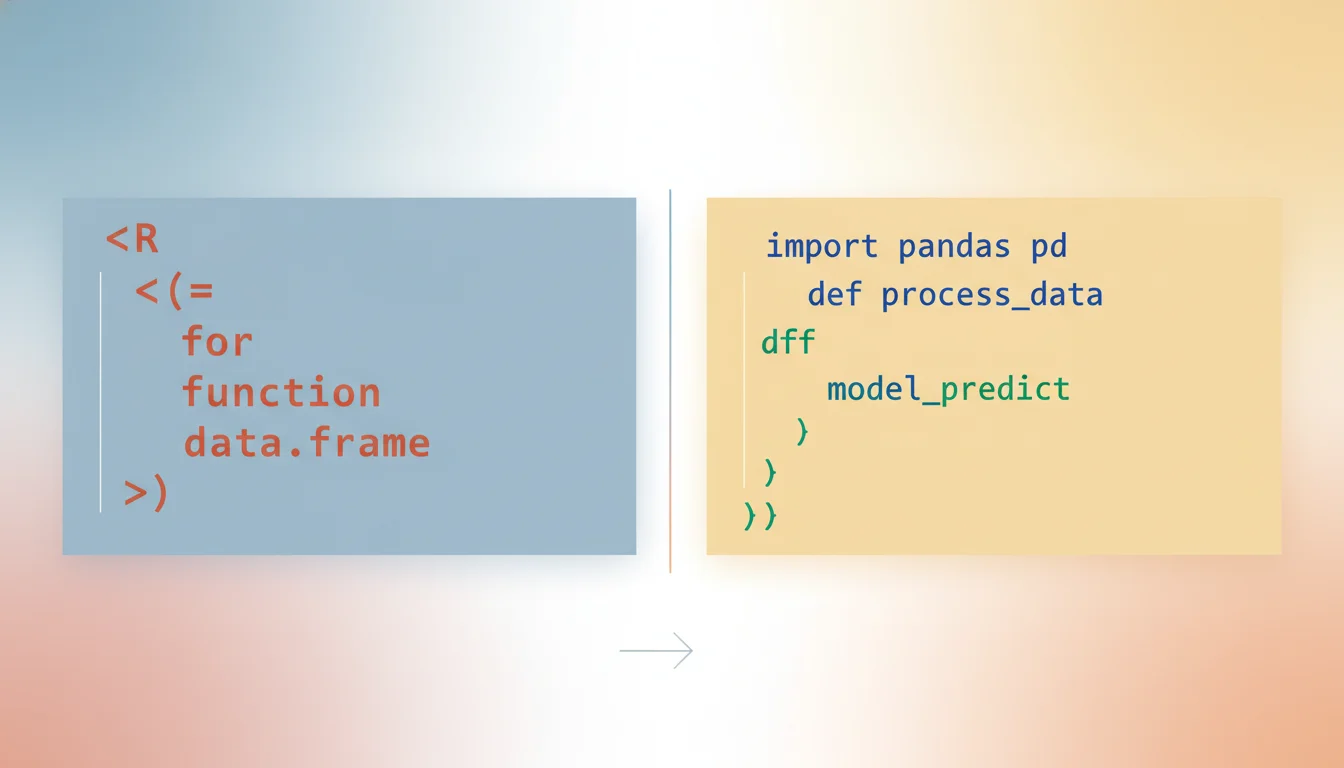
My plan was simple: I'd give this thing a shot, watch it fail spectacularly, and then go back to my boss with proof that the timeline was a fantasy. I initiated a full-on data dump. I fed the agent everything: the new database schema, a JSON file defining all the variables, my project documentation outlining the join conditions, and my notes on future state plans. Then, on a whim, I uploaded my secret weapon: my old, battle-tested R code from five years ago. I figured, let's see you make sense of this, you glorified autocomplete.
I hit enter and leaned back, ready to watch the fireworks of failure. But what blinked back at me wasn't an error message. It was a complete, functional, and logically sound workflow. My jaw physically dropped.
Immediately, my internal monologue started screaming. This can't be right. AI is 'slop'. AI is bad. AI eats jobs. It must have missed something. My mission changed. I was no longer trying to build a system; I was trying to break the AI's system. I went to war, hunting for that single, sloppy mistake that would justify my entire worldview.
My first "AHA!" moment came quickly. "AHA! You missed a crucial customer ID column in the final output table." I typed it in, feeling smug. The AI responded instantly: "You are correct. I have now repaired the code." And just like that, the code was fixed. No drama, no debugging. My smugness evaporated.
My second "AHA!" felt more solid. "AHA! Your date calculation is off by a day. It's not accounting for the fiscal quarter start." I was sure I had it. The AI's response was a gut punch. "Based on your initial documentation, the definition of a fiscal quarter was ambiguous. I made an assumption. If you clarify the rule, I will adjust." It had not only found a flaw, but it had traced the flaw back to my own sloppy documentation. I gave it the clarification, and the entire logic was refactored in seconds.
The third and final "AHA!" was my last stand. "AHA! This code is fine, but it will never run. My work machine is a low-spec potato. This will crash due to memory overload." I leaned back, certain I had finally won. This was the kind of real-world constraint a machine couldn't possibly understand. The AI processed this for a moment and then began rewriting everything. It broke the process into smaller, memory-efficient chunks, introduced batch processing, and optimized every single line for a low-spec environment. It didn't just fix the problem; it architected a more resilient solution than I would have.
The Sound of My Own Ego Deflating
After that last "fix," there was just silence. The frantic energy of my witch hunt was gone, replaced by a profound and humbling quiet. I stared at the screen, not at a sloppy tool I had outsmarted, but at a powerful partner I had been actively fighting. The code was clean. It was efficient. It was correct.
The most crushing realization wasn't that the AI was good. It was that I was holding myself back. My pride, my identity as the "guy who grinds it out," my deep-seated belief that value comes from painstaking, line-by-line labor—it was all a cage I had built for myself. A wave of shame washed over me, but it was quickly followed by an overwhelming sense of relief.
I took the AI-generated code, pushed it to the repository, and deployed it. I didn't tell a soul. It was my secret. For the next 90 days, the system ran without a single hiccup. It processed petabytes of data flawlessly. The bank was thrilled. My boss was ecstatic. The accounts team found it incredibly easy to plug into. The success was undeniable, but the story of its creation remained my own quiet, ego-shattering secret.
So, Am I Obsolete? Or Just Upgraded?
That experience didn't just refactor my code; it refactored my entire career. The fear that AI was coming for my job was replaced by a startlingly clear vision of the future. My role has fundamentally shifted. I’m no longer the guy whose primary value is typing out hundreds of lines of code. The grunt work, the tedious and time-consuming parts of development that used to eat up 80% of my time, were now automated.
My value has been pushed up the stack. I'm now an architect, a strategist, and a high-level validator. My job is to provide the vision, the business context, the documentation, and the critical eye to guide these powerful tools. I’m the one who asks the right questions, who spots the ambiguity in the documentation, and who understands the real-world constraints like a low-spec machine. The AI is the tireless builder, but I'm the one who provides the blueprint and inspects the foundation.
The old restlessness—the anxiety of impossible deadlines and manual, painstaking work—is gone. It’s been replaced by a new, far more exciting kind of restlessness. A restlessness that asks: If I can now build in eight hours what used to take me 76 days, what bigger problems can I solve? What "impossible" projects can I take on? The fear of being made obsolete is gone. I've been upgraded. And honestly, the impossible just got put on the schedule.

Antriksh Tewari
Head of Digital Marketing
Antriksh is a seasoned Head of Digital Marketing with 10+ years of experience who drives growth across digital, technology, BPO, and back-office operations. With deep expertise in analytics, marketing strategy, and emerging technologies, he specializes in building proof-of-concept solutions and transforming them into scalable services and in-house capabilities. Passionate about data-driven innovation, Antriksh focuses on uncovering new opportunities that deliver measurable business impact.