
McKinsey's Research: The AI Party might stall soon



Introduction: AI's Hype Train Hits the Brakes
Let’s be real: the hype around Artificial Intelligence, especially Generative AI, has been absolutely relentless. For the past couple of years, it’s been billed as the ultimate game-changer, the technology that’s not just knocking on the door but kicking it off its hinges. From boardrooms to brunch, the narrative has been consistent: AI is reshaping industries at a speed we've never seen, and if you’re not on board, you’re already a dinosaur.
But what if the reality on the ground looks a little... different? A groundbreaking new report from McKinsey, "The State of AI in 2024," serves as a much-needed reality check, pumping the brakes on the runaway hype train. The report exposes a massive disconnect between the near-universal adoption of AI and the actual, tangible value most companies are getting from it.

While nearly everyone is experimenting with AI, the vast majority are stuck in what can only be described as the "Great AI Stall." They’re struggling to move from cool, isolated science projects to enterprise-wide, bottom-line impact. This article dives deep into McKinsey's findings to unpack why this stall is happening, and more importantly, what the elite few "high-performing" organizations are doing to break free and achieve true escape velocity.
Everyone's in the Pool, But Nobody's Swimming Laps
One of the most eye-popping stats from the report is this: while nearly 90% of companies report using AI in some capacity, a staggering two-thirds are still just dipping their toes in the water. They’re stuck in the experimentation or piloting phase, a state of endless testing that McKinsey calls "pilot purgatory." Companies are launching proof-of-concept after proof-of-concept, but these exciting experiments rarely graduate into full-scale, integrated business solutions. Everyone’s in the AI pool, but almost no one is actually swimming laps and getting stronger.
So, what’s causing this widespread paralysis? It’s not a lack of brilliant ideas or a shortage of enthusiasm. The real roadblocks are foundational and, frankly, a lot less glamorous than building a custom GPT. The two biggest culprits are a lack of good, clean, accurate data and the absence of a sound, cloud-based technology architecture. Without high-quality data to fuel them and a robust infrastructure to run on, even the most sophisticated AI models are just powerful engines with no gas in the tank and no roads to drive on.

This foundational challenge has created a clear divide. The report shows that larger companies, those with over $5 billion in revenue, are significantly more likely to have moved beyond piloting and into the scaling phase. Why? Because they have the resources—the capital, the talent, the time—to make the massive, long-term investments in data governance and tech modernization. This allows them to build the "roads and fuel" that smaller companies are struggling to afford, creating a widening gap between the AI haves and have-nots.
The Billion-Dollar Question: Where's the Bottom-Line Impact?
Here’s where the stall becomes painfully obvious: the gap between perception and profit. According to the report, a healthy 64% of business leaders believe AI is boosting innovation in their companies. That's great! But when asked if they can attribute any real, enterprise-level EBIT (Earnings Before Interest and Taxes) gains to AI, that number plummets to just 39%. This is the heart of the problem—companies feel like they’re making progress, but that feeling isn't showing up on the P&L statement.
The reason for this disconnect is that the true cost of AI goes far beyond the tech budget. Implementing an AI solution isn't like installing a new piece of software; it's like rewiring the business itself. Achieving real value requires a holistic transformation that touches every corner of the organization, changing the fundamental tools, processes, and people. This deep, operational overhaul is expensive, complex, and time-consuming, which explains why the immediate ROI is so elusive for most.
That’s not to say there's zero value being created. The report highlights that companies are seeing measurable benefits, but they’re happening in isolated pockets. At the use-case level, AI is driving significant cost reductions in functions like Software Engineering, Manufacturing, and IT. On the flip side, it’s creating real revenue increases in Marketing & Sales and Strategy. This proves that the pilots are working—they're just not being integrated and scaled in a way that moves the needle for the entire organization.
Rise of the Agents: More Science Project Than Workforce
Just as companies are struggling with "traditional" AI, the next big thing is already here: AI agents. These are the autonomous systems that can execute complex tasks, and they’re generating a ton of buzz. Unsurprisingly, the adoption pattern mirrors the broader AI trend. A full 62% of companies are already experimenting with agents, but only 23% have started to scale them. The curiosity is high, but scaled deployment remains low.

Even among the early adopters, the use of AI agents is highly concentrated. The action is primarily happening in the Technology and Healthcare sectors, and within specific business functions like IT and Knowledge Management. The report notes that even the companies claiming to be "scaling" agents are typically only doing so in one or two functions. This confirms that for the corporate world at large, AI agents are still much more of a fascinating science project than a deployed, mission-critical part of the workforce.
The Escape Velocity: How High Performers Are Breaking Free
Amidst the widespread stall, a small but powerful group has broken away from the pack. McKinsey identifies them as "AI High Performers"—the top 6% of companies that attribute 5% or more of their EBIT directly to AI. The secret to their success isn't some magic tool or exclusive algorithm. It’s a fundamentally different mindset and a radically more ambitious approach.
The single biggest differentiator is their ambition. While about 80% of companies are using AI primarily for cost-cutting and efficiency gains, high performers are aiming for something much bigger. They are also explicitly targeting growth and innovation. In fact, these elite companies are 3.6 times more likely to say their goal with AI is "transformative change" across the enterprise, not just incremental improvements to existing processes.
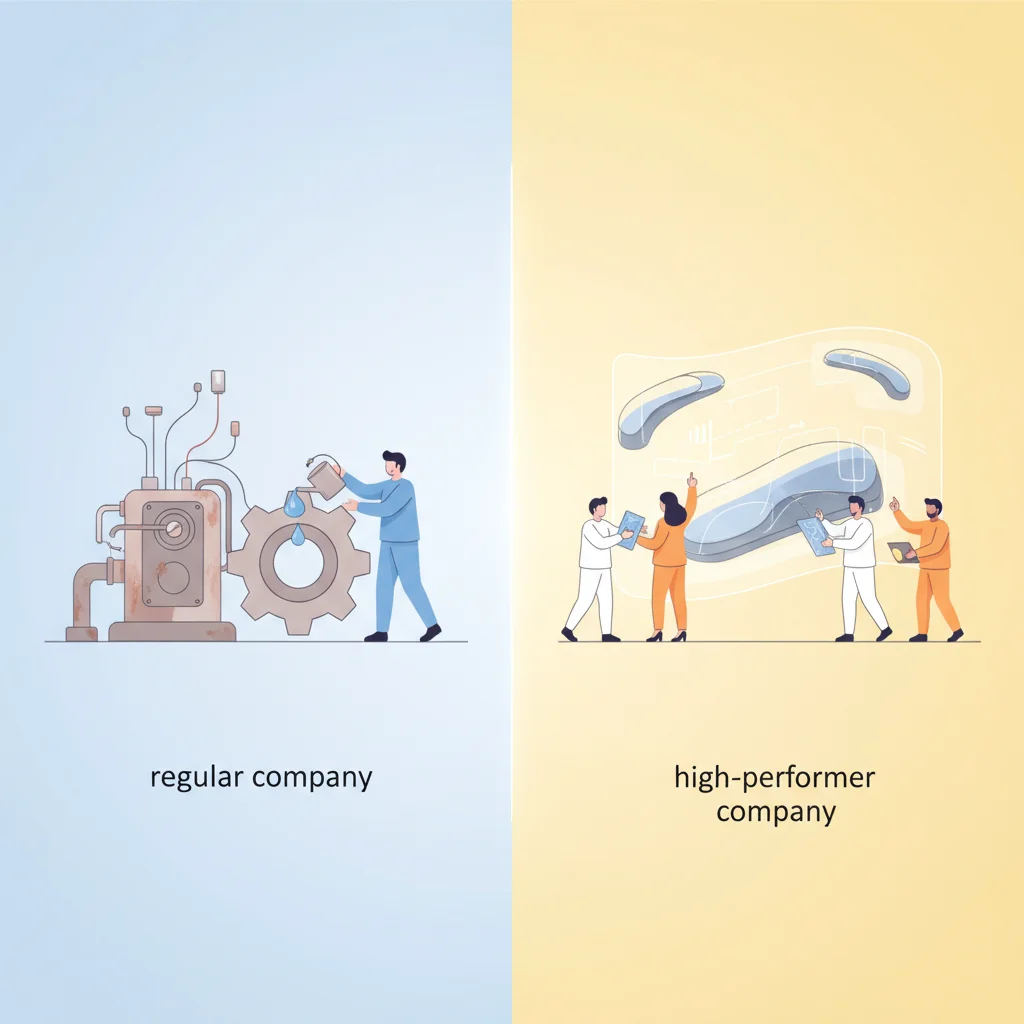
This ambition isn't just talk; it's backed by decisive action. High performers are nearly three times more likely to fundamentally redesign entire workflows around AI capabilities. They don't just plug AI into an old, clunky process and hope for the best. They start with a blank slate and build new, more effective processes from the ground up. This kind of deep transformation is only possible because it’s driven from the very top, with deep C-suite engagement and clear ownership of AI initiatives.
Of course, a bold vision requires serious resources. These top organizations put their money where their mission is. Over a third of them dedicate more than 20% of their entire digital budget to AI. They also rigorously apply a playbook of best practices across the board, from establishing clear human-in-the-loop oversight to building agile, cross-functional product teams and implementing a clear AI talent strategy to upskill and hire the right people.
Ultimately, the superpower of these high performers is their mastery of "hybrid intelligence." Their success comes from artfully blending sophisticated AI solutions with deep human expertise. They understand that AI doesn't replace people; it supercharges them. This potent combination of ambitious workflow redesign, committed senior leadership, and strategic investment in talent and infrastructure is the definitive playbook for escaping the Great AI Stall.
From Stall to Full Throttle
McKinsey's latest report makes one thing crystal clear: for most organizations, the AI revolution is currently stuck in first gear. Widespread experimentation has created a lot of buzz and a handful of promising pilots, but it has not yet translated into widespread transformation or profit. This "Great AI Stall" is the defining challenge for business leaders today.
The good news is that a path forward has already been paved by the high performers. The solution isn't just to adopt more technology faster. It’s to adopt a more ambitious vision for what that technology can do. Escaping the stall requires a top-down commitment to fundamentally transforming the business, redesigning core processes from the ground up, and making the necessary, long-term investments in data, people, and architecture. The incredible promise of AI is real, but unlocking it is a feat of bold strategy, not just smart technology.

Antriksh Tewari
Head of Digital Marketing
Antriksh is a seasoned Head of Digital Marketing with 10+ years of experience who drives growth across digital, technology, BPO, and back-office operations. With deep expertise in analytics, marketing strategy, and emerging technologies, he specializes in building proof-of-concept solutions and transforming them into scalable services and in-house capabilities. Passionate about data-driven innovation, Antriksh focuses on uncovering new opportunities that deliver measurable business impact.