
Navigating the Tectonic Shifts in 2026 Marketing Analytics



The Future Is Now: Why 2026 Is Marketing's Turning Point
Alright, let's get real. For the past few years, we’ve all been talking about the next big thing in marketing. We’ve been planning, roadmapping, and future-proofing. But the future we were prepping for? It’s officially here. In 2026, the game isn't about having the best five-year plan; it's about having the sharpest analytical intelligence. Whether that intelligence is human or artificial, it's now the single most critical factor for success in communication, connection, and sales.
The era of hypotheticals is over. We've officially entered the age of execution and adaptation. The shifts we’re seeing aren't just minor tremors; they're tectonic. The ground beneath our feet is rearranging itself, creating new landscapes for commerce, information, and influence. This isn't a time for panic, but it's absolutely a time for focus. The difference between the brands that thrive and those that get left behind will come down to one thing: how quickly they can adapt to a world that changes by the week, not by the quarter.
Consider this article your first look through D3 Alpha’s "magic lenses"—a guide to help you see the contours of this new world and warm up the strategic conversations that need to happen right now. Survival in 2026 isn't just about being good at what you do; it's about fundamentally understanding the new rules of engagement. Let's dive in.

Welcome to the Machine: When Your Next Customer is an Algorithm
For a minute there, AI in marketing was basically a super-smart creative intern. It could write blog posts, generate some ad copy, and maybe brainstorm a few campaign ideas. That was "old AI." It was helpful, for sure, but it was still just a tool we used. The new reality of 2026 is fundamentally different. We’ve graduated from AI as a content generator to AI as an autonomous agent—a force that is actively reshaping the market by doing things on its own.
This isn’t just an upgrade; it’s a paradigm shift. We’re no longer just marketing with AI; we’re marketing to AI. So, what does this actually mean for your business? How are these increasingly sophisticated AI agents changing the fundamental rules of commerce, information discovery, and customer relationships? The answer isn't just about technology; it's about rethinking the very nature of your customer.
The Last Human Shopper: Decoding Agentic Commerce
Get ready to meet your new target audience: the "machine-customer." These are AI agents, powered by sophisticated models, that are delegated the authority to make purchasing decisions on behalf of humans. Think of an AI that not only adds groceries to a list but autonomously finds the best deal on organic avocados from a sustainable supplier and orders them for you. Gartner predicts that by the end of 2026, a staggering 20% of customer service interactions will be handled by these agents.
The strategic implication here is massive and creates a fascinating new challenge. Your marketing now has to operate on two distinct levels. You must still emotionally convince the human that your brand aligns with their values, solves their problems, and understands their needs. But you also have to rationally and objectively satisfy the algorithm making the final call. That machine-customer is analyzing data, comparing specs, checking reviews, and optimizing for parameters you might not have even considered. It’s a two-front war for attention, and you have to win on both.
Beyond SEO: Conquering the New Frontier of Generative Engine Optimization (GEO)
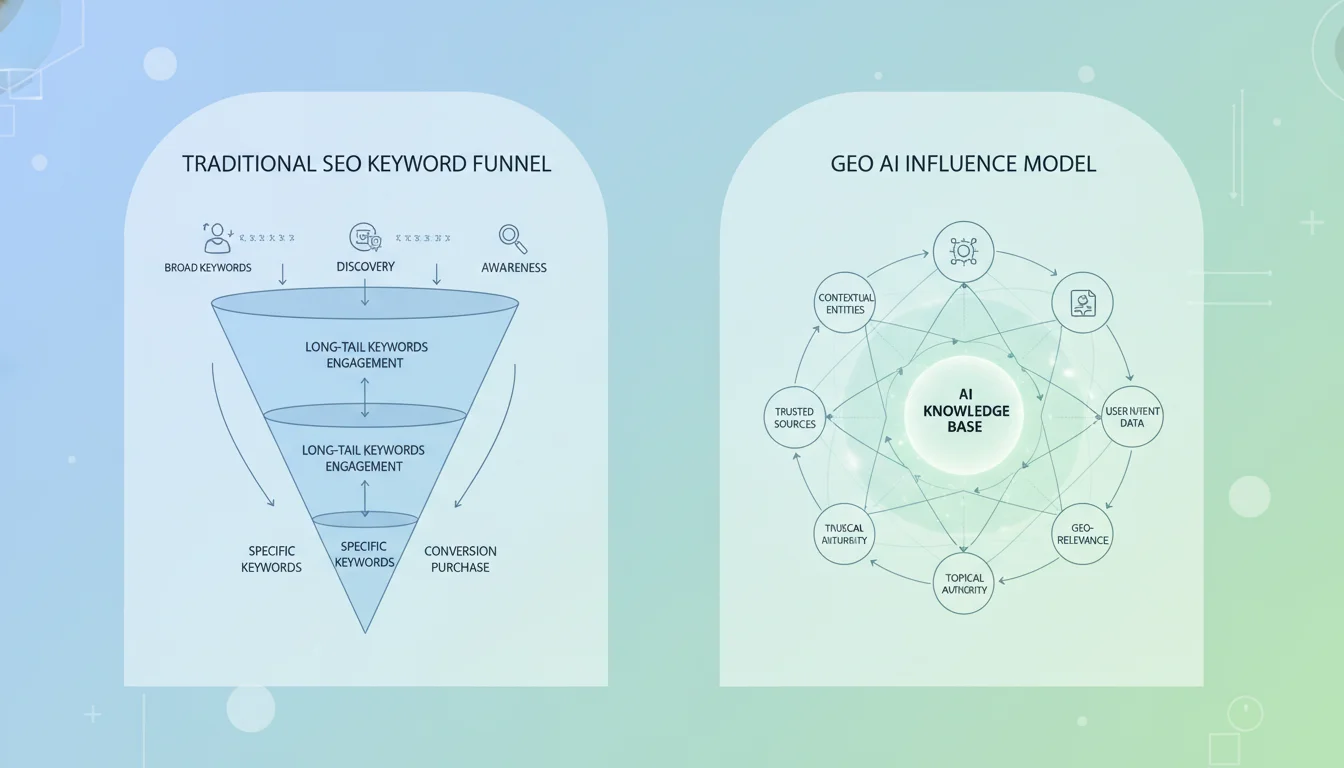
This rise of agentic commerce is directly connected to the revolution in how we find information. Traditional search, dominated by keyword-chasing and backlink-building, is being disrupted by Large Language Models (LLMs) like GPT. Instead of scrolling through ten blue links, we’re now asking an AI a question and getting a direct, synthesized answer. This is the new frontier, and it demands a new strategy: Generative Engine Optimization (GEO).
If SEO was about ranking on a results page, GEO is about becoming an essential part of the AI's "brain." It's about optimizing your content, brand narrative, and corporate reputation so that when an AI agent—or a human using an AI assistant—looks for a solution, your brand is the answer. This isn't just about tweaking product feeds; it’s a holistic effort across your entire digital footprint. The potential is enormous, with Emarketer projecting that AI/LLM Search will generate nearly $26 billion in ad revenue in its first 5 years.
In this landscape, the ultimate competitive advantage is what we call "Share of Model"—the probability that an AI model will mention, recommend, or purchase your brand. Gaining a high Share of Model means you’re not just winning a search query; you’re becoming the default, trusted solution baked directly into the new engine of commerce.
Building the Engine: The Foundational Data Your AI-Powered Future Demands
Here's the tough-love moment: you can’t win at agentic commerce or GEO if your data infrastructure is a mess. AI at scale isn't magic; it's the output of an incredibly sophisticated data engine. To leverage these new opportunities, your company's data, metrics, and systems must be ruthlessly modernized. "Good enough" is no longer good enough.
This means modern Data Lakes, well-structured and governed Data Warehouses, seamless API integrations, and robust data governance are absolutely non-negotiable. These aren't just IT buzzwords; they are the foundational pillars upon which your entire AI-powered future will be built. Without this clean, accessible, and reliable data engine, any AI initiative is destined to fail. This is precisely where D3 Alpha steps in—partnering with your IT, MarTech, and Marketing teams to design and build the technical architecture and data pipelines required to compete and win.
Is MarTech Dead? No, It’s Just Becoming Invisible
Every few years, a dramatic headline proclaims, "MarTech is Dead!" It’s a recurring myth that misses the point entirely. MarTech isn't dying; it’s evolving into something far more powerful, fluid, and, frankly, invisible. The era of clunky, siloed platforms with a dozen different logins and overwhelming dashboards is coming to an end.
We are rapidly moving from a world where we operate marketing technology to a world where we converse with it. The complexity isn't disappearing; it’s being abstracted away. The future of MarTech is less about navigating complex user interfaces and more about enabling conversation-based solutions and autonomous actions that work seamlessly in the background.
From Dashboards to Dialogues: The Conversational Revolution
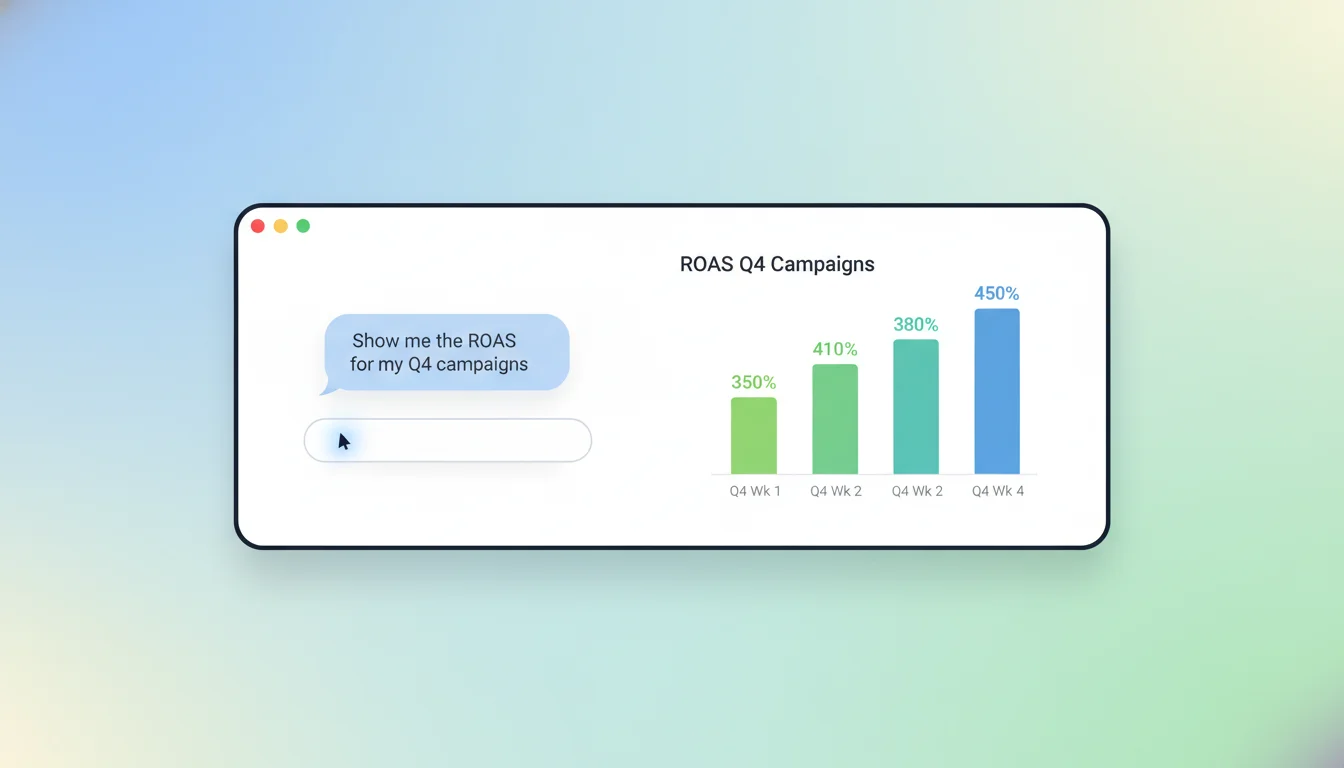
Think about the "ChatGPT effect." Why would you want to spend ten minutes hunting through a labyrinthine dashboard, applying filters, and exporting a CSV just to find a simple metric? Why go through all that when you can simply ask a question in plain English and get an instant answer? This is the conversational revolution in analytics and operations.
This approach scales beautifully from the simple to the complex.
- Simple Queries: "How many conversions did we get from our holiday campaign last week?"
- Deep Analysis: "Run a regression model to estimate the contribution of each channel to new user sign-ups, controlling for seasonality."
- Direct Execution: "Find my five worst-performing ad groups by ROAS and pause them."
This is made possible by what some are calling "Vibe Coding"—the ability to use natural language to program and execute tasks. This low-code/no-code approach empowers marketing teams to create their own proprietary micro-tools on the fly, reducing their dependency on monolithic MarTech suites and dramatically accelerating their speed of execution.
The New Handshake: How MCP Unites Your Autonomous Marketing Stack
So, if every team is building micro-tools and using different AI agents, how does it all work together? The answer lies in a new standard we call MCP (Model Context Protocol). Think of MCP as the USB-C of the AI world—a universal connector designed to allow different AI agents, models, and solutions to "talk" to each other and share context seamlessly.
MCP is the new handshake for your tech stack. It's the protocol that allows an insight generated by your analytics bot to be passed to your campaign optimization agent, which then communicates with your content generation model to spin up a new creative. It’s the connective tissue for an autonomous marketing ecosystem. MarTech isn't going away; it's atomizing into a swarm of hyper-specialized, conversational agents that are becoming so well-integrated and autonomous that the "old" way of manually logging into ten different platforms will soon feel comically obsolete.
The End of Absolute Certainty: Crafting Your Composite Truth
The death of the third-party cookie wasn't the final boss battle; it was just the tutorial level. By 2026, the idea of perfect, deterministic, 1-to-1 measurement is a rare and fleeting luxury. The data signals are murkier, the customer journey is more fragmented, and privacy regulations are (rightfully) stricter than ever.
This is the new paradigm for mature marketing organizations. Chasing the phantom of absolute truth is a fool's errand. The goal is no longer certainty, but "directional precision." This is achieved by systematically building a "composite truth"—a holistic and reliable picture of performance crafted by integrating and triangulating insights from multiple, imperfect data sources.
The Power of Three: Triangulating Success with MMM, Attribution, and Experimentation
In this new reality, relying on a single measurement methodology is a recipe for disaster. The future is all about triangulation, and the three most critical pillars of your composite truth are Marketing Mix Modeling (MMM), Attribution, and Experimentation. Each plays a distinct and complementary role.
- Marketing Mix Modeling (MMM): This top-down, statistical approach is experiencing a major renaissance for good reason. It’s privacy-compliant and provides a strategic, big-picture view of your channel performance. Emarketer's data confirms this, projecting that 46.9% of marketers will increase their investment in MMM. It's the new cornerstone of strategic budget allocation.
- Attribution: While imperfect, multi-touch attribution models provide the speed and granularity that MMM lacks. They are your tactical, in-the-moment guide for campaign optimization and pacing.
- Experimentation: Controlled experiments (like lift studies and A/B tests) are your source of ground truth. They are the ultimate reality check, allowing you to validate the deeper hypotheses generated by your MMM and attribution models with stark, scientific clarity.
Of course, the biggest challenge is often organizational. Embracing a composite truth means being willing to accept data-driven insights that may challenge long-held beliefs or pet projects. But making those tough, evidence-based decisions is precisely what will separate the high-performers from the rest of the pack.
Retail Media's Next Leap: Moving Beyond Last-Click to Real Impact
It’s no secret that ad budgets are flocking to Retail and Commerce Media Networks. The reason is simple: they hold the promise of closing the loop between ad spend and actual sales, offering a clearer path to attribution in a post-cookie world. But here's the critical challenge for 2026: most of these platforms still operate on basic, last-click attribution models that tell a dangerously incomplete story.
To truly unlock the value of this channel, both retailers and the advertisers on their platforms need to start asking—and answering—more sophisticated measurement questions. What is the true lifetime value (LTV) impact of an upper-funnel video branding campaign? How do in-store activations influence online sales for a specific product category? How much credit does a sponsored search ad really deserve when the customer was already exposed to three other touchpoints?
This is where advanced measurement comes in. By leveraging multichannel attribution, omnichannel analysis, and the power of Data Clean Rooms (DCRs), D3 Alpha helps both retailers and advertisers move beyond simplistic metrics. We build more realistic, in-depth measurement frameworks that reveal the true, incremental impact of your investments and unlock the next wave of growth in commerce media.
Adapt or Be Obsolete: Your 2026 Mandate for Growth
Let’s put it all on the table. 2026 will not be a year for amateurs. It won’t be a year for those waiting on the sidelines to see what happens. The currents of change are too strong, and the pace of innovation is too fast. The mandate is clear: evolve your strategy, your technology, and your thinking, or you will be rendered obsolete.
This is the core of D3 Alpha's mission. We are not just consultants; we are strategic partners in your evolution. We exist to ensure your data architecture is ready for an AI-first world, your measurement methodologies are scientifically valid and business-focused, and your brand is positioned to thrive in a new ecosystem where your next customer may not even be human.
The complexity of 2026 can be overwhelming, but it's also brimming with opportunity for those who are prepared. The time to get ready is now.
Ready to turn the complexity of 2026 into consistent, business-driving impact? Contact D3 Alpha today, and let's start building your future-proof data, measurement, and marketing strategy.

Antriksh Tewari
Head of Digital Marketing
Antriksh is a seasoned Head of Digital Marketing with 10+ years of experience who drives growth across digital, technology, BPO, and back-office operations. With deep expertise in analytics, marketing strategy, and emerging technologies, he specializes in building proof-of-concept solutions and transforming them into scalable services and in-house capabilities. Passionate about data-driven innovation, Antriksh focuses on uncovering new opportunities that deliver measurable business impact.