They Charge $200k For This: The McKinsey Problem-Solving Playbook for One-Person Empires


The $200,000 Secret Weapon You Can Steal for the Price of a Paperback
I once sat in a corporate boardroom and watched a team of consultants from a top-tier firm present a strategy deck that cost my company a cool $200,000. As they clicked through the slides, a weird feeling washed over me. We already knew this. The data was ours, the insights were things we’d vaguely discussed over lukewarm coffee, and the big recommendation was, well, kinda obvious. Yet, there was no denying the power in the room. The executives were nodding. The plan was approved. They got the check.
For years, I was haunted by that meeting. Were they geniuses? Did they have some secret knowledge I didn't? The answer, I eventually learned, was no. They weren't necessarily smarter. They just had a better system for thinking. They had a playbook for untangling complex problems that turned messy, emotional business challenges into a clear, logical roadmap. They had a structured process for getting from "Oh crap, what do we do?" to "Here's the exact plan, backed by data."
As solopreneurs—the proud founders of our "one-person empires"—we don't have a $200k budget for a fancy consulting deck. But we face the same kinds of messy, high-stakes problems every single day. The good news? We don't need the budget. We can steal their entire playbook. It's been decoded and laid out in books like Cracked It!, and it's a system that solves the single biggest reason most creators and solopreneurs fail: they get obsessed with building the solution before they truly understand the trouble.
Your Brain's Rush to Judgment is Killing Your Business
Let’s be real: your brain is a brilliant, pattern-matching machine that’s hardwired to jump to conclusions. It’s a survival mechanism. But in business, it’s a liability. This cognitive shortcut has a name: the "Othello Trap." It’s the tendency to make a snap judgment based on limited, often emotional, evidence and then stick to it, ignoring all contradictory facts. It’s seeing Desdemona’s handkerchief and concluding, with absolute certainty, that she’s unfaithful.
Cognitive scientists call this "System 1" thinking. It's the fast, intuitive, story-telling part of your brain. It’s what helps you drive a car without consciously thinking about every single action. But when you apply it to a complex business problem, it goes haywire. It creates a plausible-sounding story from a few data points and a lot of feeling. That "gut feeling" you're so proud of? It’s often just your anxiety in a trench coat, whispering sweet, panicked nothings in your ear.

For us solopreneurs, the Othello Trap is everywhere. You see one negative YouTube comment and your System 1 brain screams, "Everyone hates me, my business is a failure!" You have a slow launch day and your gut immediately tells you to slash the price in a panic. This is your brain telling you a story, not the objective truth. It’s fueled by a few nasty sub-traps:
- The Expertise Trap: Assuming the skills that made you a great designer or writer automatically make you a great marketer or financial planner.
- Misleading Analogies: "What worked for Apple will work for me!" No, it won't. Your context is completely different.
- WYSIATI ("What You See Is All There Is"): Making massive decisions based only on the information directly in front of you, without ever asking, "What am I not seeing?"
The 4S Method: Your Blueprint for Disciplined Problem-Solving
So how do we escape our brain's default settings? We need a system. The antidote to the guessing game of System 1 is the 4S Method: State, Structure, Solve, and Sell. This is the core framework used by elite consultants, and it's the ultimate meta-skill for any entrepreneur. It’s a disciplined process that forces you to slow down at the beginning so you can move with blistering speed and accuracy later.
Think of it this way: running a business is like being a doctor. A bad doctor hears a cough and immediately prescribes the first medicine that comes to mind. A great doctor asks questions, runs tests, and diagnoses the root cause before ever writing a prescription. The 4S Method turns you into a great doctor for your business.
Here's the 30,000-foot view:
- State: First, you define the problem with absolute, surgical precision. No assumptions, no fuzzy language. What is the exact trouble we're trying to solve?
- Structure: Next, you break that big, scary problem down into its component parts. You create a logical map of all the possible issues and drivers.
- Solve: This is where you do the work. You gather data, run experiments, and analyze the pieces of your structured map to find the root cause and the best path forward. This is about data, not "vibes."
- Sell: Finally, you create a clear, compelling story around your solution to get buy-in. Whether you’re "selling" to a client, your audience, or just yourself, a brilliant solution that can't be communicated is worthless.
This framework represents a fundamental mindset shift. You stop treating your business like a series of random fires to be put out and start treating it like a system to be engineered.
Use the TOSCA Framework to Stop Wasting Your Life on the Wrong Work
I once spent three weeks meticulously crafting a "perfect" welcome email sequence for my newsletter. I wrote, I edited, I designed. When I launched it, the open rates were great... but it had zero impact on sales. Why? Because I had misdiagnosed the problem. I thought the problem was trust (which a welcome sequence builds), but the real problem was traffic (I didn't have enough of the right people signing up in the first place). I solved the wrong problem beautifully.
This is where the TOSCA framework comes in. It’s the deep-dive tool for the State phase of the 4S Method, and it’s your best defense against wasting weeks of your life on the wrong work. Before you write a single line of code or record a single video, you must be able to answer these five questions. Write them down. Seriously.
- Trouble: What is the specific symptom that’s causing pain? What’s the gap between where you are and where you want to be? Don't say "I need more sales." Say, "My e-commerce conversion rate dropped from 3% to 1.5% in the last 60 days." Be specific.
- Owner: Who is the ultimate decision-maker responsible for this problem? For a one-person empire, the answer is almost always you. Acknowledging this is step one.
- Success Criteria: How will you know, in no uncertain terms, that you have won? What is the measurable outcome? "Get the conversion rate back to 3% within 90 days" is a clear success criterion. "Improve the website" is not.
- Constraints: What are the real-world limits you're working within? This includes your budget, your time, your technical skills, or team capacity. Be brutally honest.
- Actors: Who are the key stakeholders involved or affected? This could be your customers, your audience, a virtual assistant, or even your family.
Vague goals lead to vague results. TOSCA forces you to be surgically precise. It’s the five-minute diagnostic that can save you five weeks of wasted effort.
Untangle Complexity with MECE Issue Trees
Most business problems feel like a tangled ball of yarn. "How do I grow my YouTube channel?" or "How can I increase my monthly income?" are huge, messy questions. Your brain sees that mess and either panics or latches onto the first, most obvious thread. This is where you need a tool to impose order on the chaos.
Enter the Issue Tree, the primary tool for the Structure phase. An issue tree is a simple but profound way to break a major problem down into smaller and smaller components until you have a set of specific, testable hypotheses. The golden rule of creating an issue tree is the MECE principle:
MECE = Mutually Exclusive, Collectively Exhaustive
- Mutually Exclusive: Each branch of your tree is completely separate. There's no overlap.
- Collectively Exhaustive: All possible options are covered. You haven't left any major stones unturned.
Let's use the classic example: "How can we increase profits?" A MECE breakdown would be:
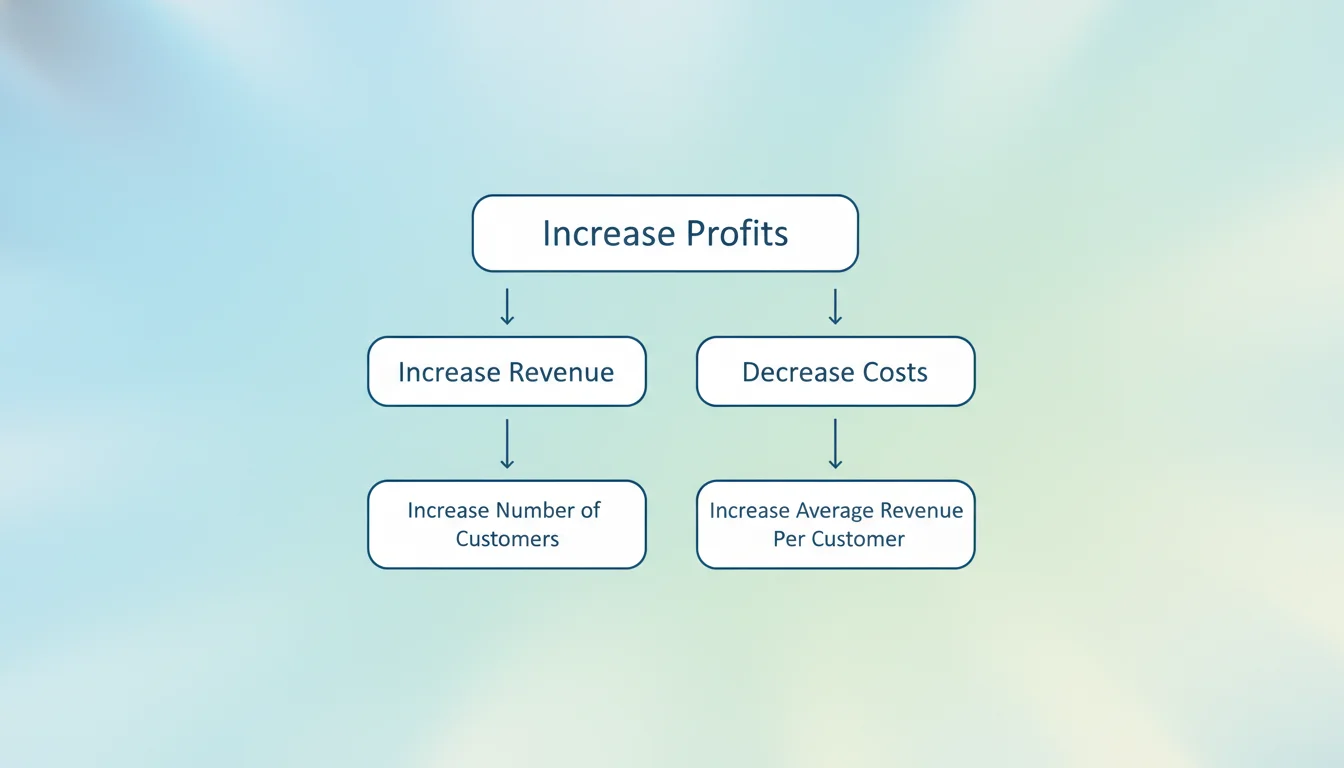
- To increase profit, you can either Increase Revenue OR Decrease Costs. These are mutually exclusive (an action can't be both at the same time) and collectively exhaustive (there is no third way to increase profit). It's MECE.
- Now, let's break down "Increase Revenue." To do that, you can either Increase the Number of Customers OR Increase the Average Revenue Per Customer. Again, it's MECE.
You keep breaking the problem down until you have concrete things you can actually investigate. A vague goal like "get more customers" becomes a set of testable hypotheses: "Is our customer acquisition cost too high?", "Is our lead-to-customer conversion rate too low?", "Is our churn rate a problem?" This process transforms you from a frantic guesser into a calm, methodical diagnostician.
When Logic Fails, Use Empathy: Hacking Human Behavior with Design Thinking
Sometimes, your problem isn't a spreadsheet problem; it's a human problem. An issue tree can tell you what part of your funnel is broken (e.g., a low conversion rate on the checkout page), but it can't tell you why. For that, you need a different tool for the Solve phase. Logic works for spreadsheets. Empathy works for customers.
This is where you layer in principles from Design Thinking. Instead of just looking at the numbers, you seek to understand the human experience behind them. Why are people abandoning their carts? Are they confused? Do they not trust the payment processor? Are they getting distracted?
For solopreneurs, you don't need a full-blown design sprint. You can use a few key tactics:
- Observe "Extreme Users": Don't just talk to your average customer. Talk to your biggest superfan and someone who tried your product and hated it. The extremes reveal non-obvious insights that the "middle" often hides.
- Create User Journey Maps: Literally map out every single step a customer takes, from discovering you on social media to buying your product and beyond. Where is the friction? Where is the delight? Where do they get stuck?
- Prototype Cheaply and Early: Before you spend 100 hours building a new course platform, mock it up in a Google Doc. Before you design a complex app, draw it on paper. Create the lowest-fidelity version of your idea possible to get real user feedback before you over-invest.
The Pyramid Principle: How to Communicate with Killer Clarity
You've done the work. You've stated the problem, structured it, and solved it. Now comes the final, crucial step: Sell. You have to communicate your findings and recommendation with such clarity that action is the only logical next step. This is where most people fail. They communicate chronologically, taking their audience on the long, winding journey of their analysis. "First, I looked at this, and then I found that, and then I analyzed this other thing..." By the time they get to the point, their audience is asleep or checking Instagram.
The solution is Barbara Minto's Pyramid Principle: Lead with the answer first.
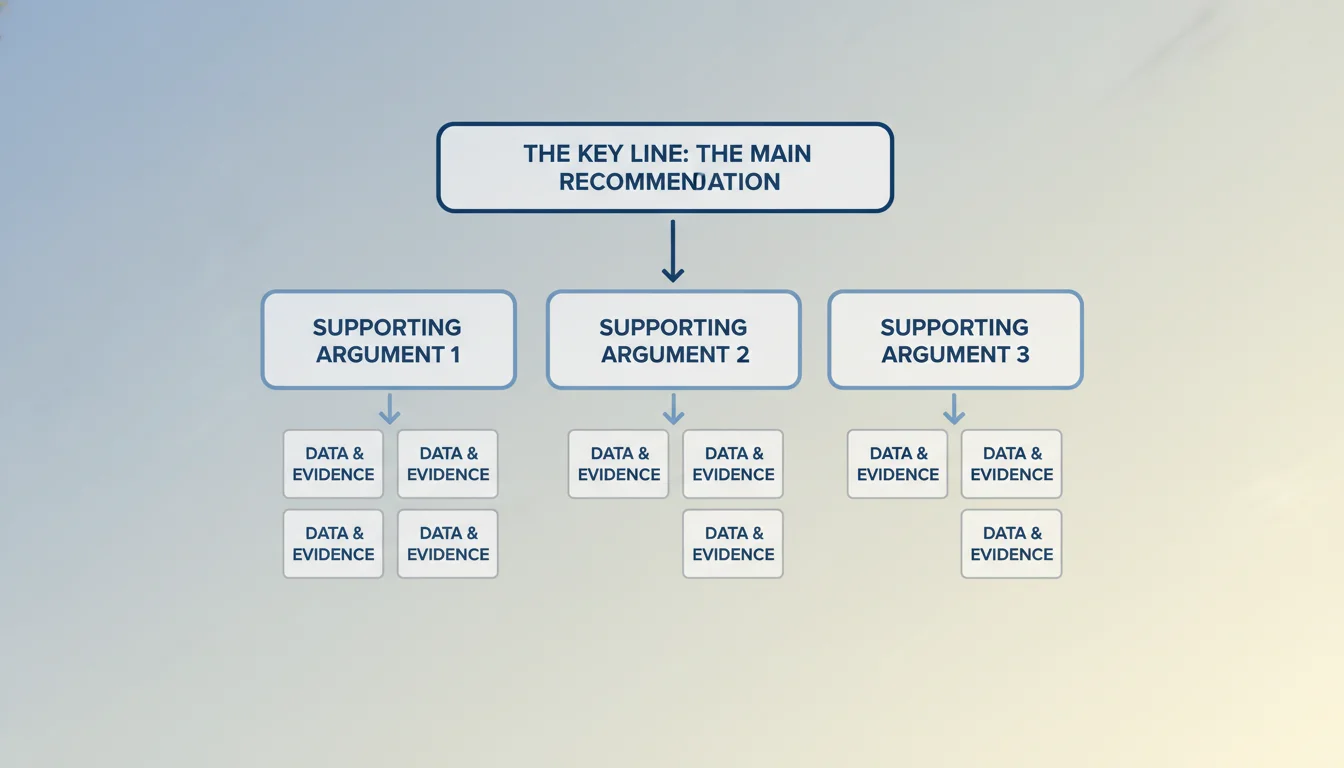
The structure is simple and powerful:
- The Key Line: Start with your single main recommendation. The one sentence you want your audience to remember.
- The Support: Immediately back up your key line with your 3-5 major supporting arguments, laid out in a logical order.
- The Data: Underpin each argument with the data, evidence, and examples that prove it's true.
This structure respects your audience's time and cognitive load. It gives them the "so what" right up front. For your content, your sales pages, or even just clarifying your own thinking, this is a game-changer. Use the SCR framework (Situation, Complication, Resolution) to craft killer intros, and always use "Action Titles" for your slides or sections. Instead of a passive title like "Social Media Data," use an active one like "Instagram Ads Reduced Lead Cost by 40%."
Stop Trusting Your Assumptions: The Art of Rigorous Analysis
Early in my journey, my Twitter account was growing fast. My ego loved it. I assumed this growth was driving my newsletter sign-ups. I spent months doubling down on my Twitter strategy, only to realize later that the correlation was spurious. The real driver of my sign-ups was a guest post I had written on a popular blog. I mistook a "given" for a fact and wasted a ton of time.
Rigorous analysis, the engine of the Solve phase, is about ruthlessly questioning your own assumptions. It’s about building a case so strong it can withstand scrutiny. As a solopreneur, you have to be your own toughest critic. Watch out for these analytical traps:
- Survivor Bias: It's easy to look at the one creator who blew up by posting 10 TikToks a day and think, "That's the blueprint!" You're ignoring the 10,000 other creators who did the same thing and got zero results. Analyze the failures, not just the spectacular successes.
- Implicit Assumptions: Every plan has hidden guesses. "I assume my audience is willing to pay $100 for this," or "I assume I can build this in a weekend." Make those assumptions explicit. Write them down. This turns a guess into a hypothesis you can actually test.
- Lack of Sensitivity Analysis: Your financial model looks great, but what happens if your conversion rate is 20% lower than you projected? What if your ad costs are 30% higher? A robust plan doesn't break if one number is slightly off. This is what separates a fragile side hustle from a sustainable business.
Don't Get Trapped: Your 10-Minute Path from Insight to Impact
This playbook is powerful. It’s a system for thinking clearly and making better, faster decisions. But be warned: knowledge without action is just procrastination in a suit. The goal isn't just to understand these frameworks; it's to use them.
This brings us to the final balancing act: The "Goldilocks Rule." You must avoid both the Othello Trap (acting too quickly on pure emotion) and the "Hamlet Trap" (getting stuck in endless analysis, forever debating and never deciding). The frameworks you've just learned are your path through the middle—just enough structure to ensure clarity, but not so much that you're paralyzed.
So let’s make this real. Right now. I want you to run a 10-minute experiment. Think of the single biggest bottleneck, frustration, or problem in your business. The one that’s been rattling around in your head for weeks. Got it? Now, open a blank document and answer the five TOSCA questions about it.
- Trouble: What is the specific, measurable symptom?
- Owner: It's you. Write it down.
- Success Criteria: What does a "win" look like in 90 days? (Be specific!)
- Constraints: What's your real budget? How much time can you really give this?
- Actors: Who does this affect?
Just by doing this, you will have more clarity than 90% of entrepreneurs who are still just "thinking" about their problems. You will have taken the first step from reacting to engineering.
So, what's the one problem you've been "thinking" about for weeks that you're finally going to define today?

Antriksh Tewari
Head of Digital Marketing
Antriksh is a seasoned Head of Digital Marketing with 10+ years of experience who drives growth across digital, technology, BPO, and back-office operations. With deep expertise in analytics, marketing strategy, and emerging technologies, he specializes in building proof-of-concept solutions and transforming them into scalable services and in-house capabilities. Passionate about data-driven innovation, Antriksh focuses on uncovering new opportunities that deliver measurable business impact.
Recommended for You

The Shocking Truth About Your Top Products: How Many Are Actually Making (Or Breaking) Your Business?

The Most Dangerous Advice in the World: 'Start a Business'